A Webbing Journey
- 4.8
- Rating
- 5.00M
- Installs
- Free
- Price

 Analysis by App-foxy
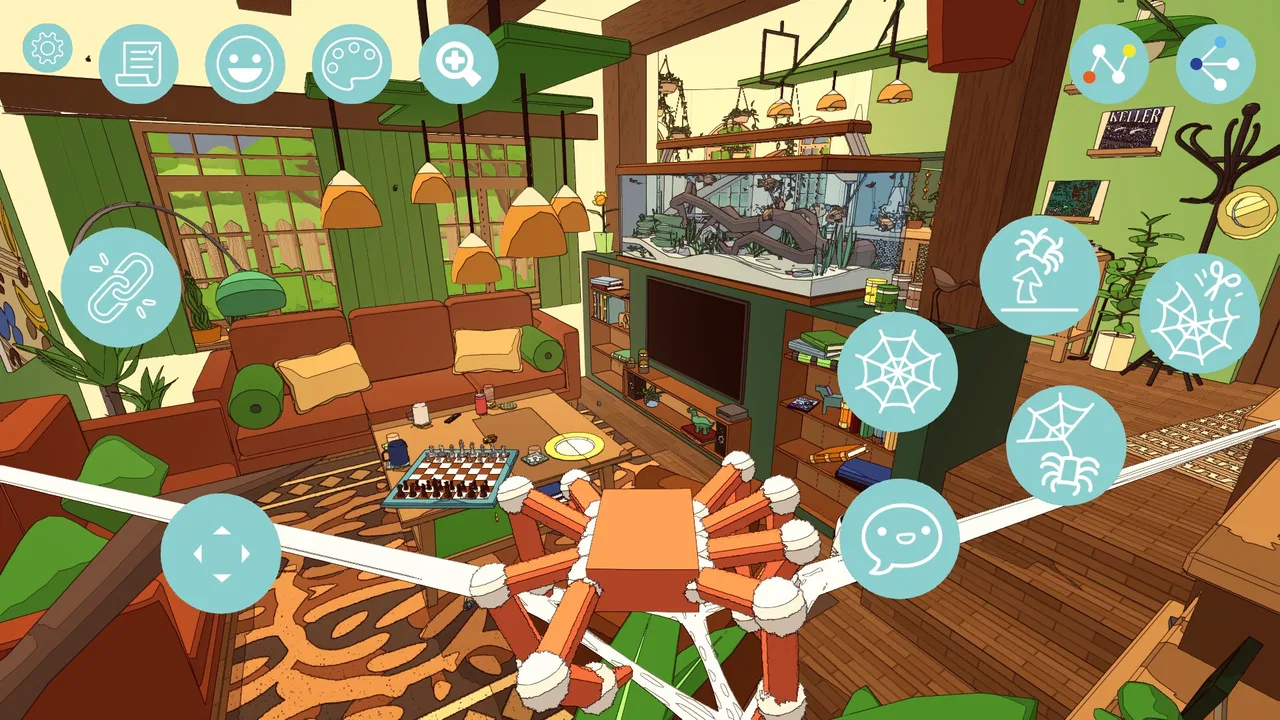
I found A Webbing Journey most appealing when I stopped treating it like a conventional level-based adventure and started treating it like a small interactive playground. You guide a cute spider through spaces where movement, momentum, and webbing matter more than simply walking from one marker to the next. That makes the game feel gentle at first, but it also asks you to observe carefully and experiment instead of rushing.
It is a free adventure game from Fire Totem Games GmbH, available for players rated Everyone. The store summary describes a physics-based sandbox, and that is the right expectation: this is less about constant combat or a long cinematic plot and more about learning how a tiny character behaves in a responsive environment. The short description, “Webbing Journey,” captures the mood better than a promise of nonstop action.
The game has reached over a million installs and holds a 4.6 average from around fourteen thousand ratings, so it has clearly found an audience beyond a small experimental release. I can understand why. Its central idea is easy to grasp, visually friendly, and unusual enough to stand apart from ordinary platform adventures. At the same time, its physics focus means it will not satisfy everyone, especially players who want precise, traditional controls or a clearly signposted objective at every moment.
You May Also Like

 Blood Strike: 2.5 Anniversary
Blood Strike’s Loadouts Turn Every Drop Into a Tactical Gamble
A close look at Blood Strike’s custom loadouts: how fast access to signature weapons reshapes its battle royale rhythm, rewards preparation, and narrows the gap between fights.

 Pandora - Music & Podcasts
Pandora’s Music Is Easy to Start, but Harder to Recover
Pandora’s strength is its low-effort path from a seed to a station. Its weak spot is how much confidence it asks you to place in connection, setup, and quiet recovery.

 8 Ball Pool
 Is Built on Rivalries, Rematches, and Routine
A close look at the rivalries, rematches, shared routines, and unanswered safety questions that turn a quick pool match into a persistent mobile community.

 Samsung Music
’s Quiet Strength Is Playing What You Already Own
Its reach comes less from spectacle than from dependable access to a personal library. That simplicity is both the app’s strongest retention engine and its ceiling.

 AccuWeather: Weather Radar
AccuWeather Review: A Quick, Clear Forecast for Everyday Decisions
For everyday plans, the best forecast is the one you can understand quickly. AccuWeather makes rain timing, radar, and local conditions easy to act on, with a few trade-offs.

 Hill Climb Racing
Why Hill Climb Racing Still Turns Crashes Into One More Run
A tiny car, a bumpy hill and one more upgrade: Hill Climb Racing keeps resurfacing because its simple chaos makes every near-miss feel personal.
More From Our News Desk



Getting comfortable with the spider and the world
When I first start a game like this, I want to know whether the opening minutes teach me what to do without making me feel clumsy. Here, the important adjustment is accepting that movement may not behave like a standard platformer. A spider’s position, the surfaces around it, and the way webbing connects actions together all affect what happens next. The best early approach is to move slowly and watch the result of each action rather than immediately trying to cross the whole screen.
That change in pace is important. In a typical adventure game, I might hold a direction and expect the character to respond in a predictable line. In this one, I get more from short inputs and deliberate positioning. If a movement fails, I do not automatically read it as a bad control scheme; often it means I approached the surface from an awkward angle or attempted a web action before creating a useful position.
The sandbox design also makes the surroundings part of the challenge. I pay attention to edges, gaps, open space, and reachable surfaces before committing to a route. This turns each small area into a practical puzzle. The question is not only “Where should I go?” but also “What can I attach to, and what will happen if I use that point now?” That is a more interesting question than simply following arrows, although it can feel vague if you prefer direct instructions.
For a first-time player, I recommend spending the opening session learning the rhythm rather than trying to make perfect progress. Test a safe movement, notice how the spider settles, then try a web-based action when you have room to recover. This makes the controls feel less mysterious and reduces the temptation to blame the game after a failed attempt.
What the free download means in practice
The game is free to download, with in-app purchases ranging from $1.99 to $5.99 per item. That makes it easy to try before deciding whether it deserves a place on your phone or tablet. I would still approach the purchase options as optional extras rather than part of the reason to install it. The core decision is whether you enjoy the physics-driven style; spending money will not change the fact that the game asks for patience and experimentation.
Because the age rating is Everyone, it is a reasonable candidate for a child-friendly shared device or for adults looking for something calm and playful. I would nevertheless play the opening section myself before handing it to a younger child, not because the tone is unsuitable, but because the open-ended controls may require explanation. A child who expects immediate, obvious objectives could otherwise mistake the game’s quiet design for a lack of direction.
The current version is 0.13.3, and the game was released on May 18, 2023. I mention this because the experience feels like the kind of project where the way you respond to its mechanics matters more than a huge feature checklist. If you are installing it for a polished, conventional adventure with a heavily scripted presentation, your expectations may be mismatched from the beginning.
The first meaningful success
My first satisfying moment came from treating a web connection as a tool for planning rather than a button to press repeatedly. I looked for a stable place to begin, positioned the spider with enough space around it, and then used the available surface to create a more controlled route. The success was modest, but it taught me the central lesson: progress feels better when I understand why an action worked.
For a new player, I suggest setting a small goal such as reaching one nearby surface or getting across a single awkward gap. Do not measure the first session by how far you travel. Measure it by whether you can repeat one successful movement. Once you can do that, the rest of the game becomes less intimidating because you have a reliable starting technique.
A useful habit is to pause mentally before every difficult attempt. Identify the surface you want, check whether the spider is positioned comfortably, and consider where the character might end up if the action goes slightly wrong. This is especially helpful in physics-based play, where a technically correct input can still produce an inconvenient result if the setup is poor.
Another practical tip is to avoid making several changes at once. If you move, attach webbing, and immediately redirect yourself without observing the result, it becomes difficult to know which part caused the failure. I get better results by changing one variable at a time. That makes the game feel like a small experiment, and it gives each retry a purpose instead of turning it into random tapping.
Why the controls can feel confusing
The biggest source of friction is the difference between intention and outcome. I may want the spider to travel toward a particular spot, but the physics can make the route less direct than expected. A failed attempt can leave me wondering whether I missed the correct input, chose a poor attachment point, or simply asked for too much movement from the current position.
When that happens, I return to a simple checklist. First, I check whether the spider is close enough to interact with the surface I have chosen. Next, I make sure I am not attempting a long, complicated maneuver when a shorter move would give me a better starting position. Finally, I look at the space around the destination and ask whether the spider has somewhere safe to settle. This process is more useful than repeating the same gesture with greater speed.
The game’s charm depends on this physical uncertainty, but that is also its clearest limitation. Players who love precise jumps, fixed trajectories, and instant responses may find the movement loose. Players who enjoy discovering how systems behave will probably see the same looseness as the main attraction. I would not recommend it as a replacement for a tightly tuned platformer; it is aiming for a different kind of satisfaction.
Another possible confusion is the lack of a conventional adventure rhythm. If you are waiting for a constant stream of dialogue, combat encounters, or obvious mission prompts, the quieter sandbox structure may feel underdeveloped. I prefer to think of it as a game for short periods of focused play. It works well when I have time to explore one problem, try a few approaches, and stop after a small breakthrough.
A practical routine for the first session
For someone installing it today, my suggested routine is straightforward. Begin with the smallest movement you can make safely. Then repeat a similar action from a slightly different position. After that, try using webbing to solve a nearby obstacle rather than reaching for the most ambitious route. This sequence teaches control, positioning, and planning in that order.
If a maneuver fails three times in the same way, I would not keep forcing it. Move back to a safer area and test whether the problem is your angle, timing, or choice of surface. Physics games often reward changing the setup more than improving the speed of the input. That is one of the less obvious lessons here, and it saves a lot of frustration.
I also recommend playing with enough attention to see the spider’s full movement. This is not an ideal game to operate while distracted by a conversation or a television show. Small positional differences can decide whether a web action creates a useful path or leaves the character in an awkward place. A few quiet minutes of concentration are more productive than a longer session of hurried attempts.
For a parent or a new player helping someone else, the best explanation is not a list of commands. Instead, demonstrate the idea of choosing a surface, making a small connection, and observing the result. That gives the learner a way to reason about the environment. It also avoids turning the game into a memorization exercise, which would miss the point of its sandbox design.
Who will enjoy it, and who should look elsewhere
I think this is a strong fit for players who like gentle experimentation, unusual movement, and small environmental challenges. It is especially suitable if you enjoy games where failure teaches you something and where a successful action feels earned because you worked out the setup. The cute spider gives the experience a welcoming personality without removing the need to think.
It is less suitable for someone seeking a fast adventure with a clearly marked route, constant rewards, or highly competitive action. It may also frustrate players who dislike retrying a maneuver after an unexpected physical result. If your favorite mobile games depend on exact jumps and immediate control, a traditional platformer would probably be a better choice.
Compared with ordinary adventure games, this one puts more responsibility on the player to interpret the environment. Compared with puzzle games, it gives less comfort through fixed solutions because the physical behavior can make the route feel active and changeable. Compared with casual time-fillers, it demands more attention but offers a more distinctive sense of discovery. That middle ground is where it works best.
A realistic everyday use case is a short evening break after work or school. I can open it, focus on one troublesome gap, and play until I understand a better route without needing to remember a complicated story. It also suits a shared moment with a friend or child, because watching the spider attempt a strange maneuver can be entertaining even before the solution is found. I would not choose it for a commute when I expect interruptions, since losing concentration during a delicate movement can make the session feel more frustrating.
Moving beyond the first breakthrough
Once the basic movement starts to feel natural, the next step is to stop asking only whether a route is possible. I begin asking whether it is efficient, safe, or repeatable. A route that works once through luck is not as useful as one I can recreate from a stable position. This distinction gives the sandbox more depth than the first few minutes suggest.
I also find it helpful to treat failed attempts as information about the environment. If the spider repeatedly ends up short of a surface, I adjust the starting point rather than simply trying harder. If the character overshoots, I look for a nearer connection or a calmer approach. These small observations turn trial and error into a method, which is the game’s most rewarding long-term habit.
There is a trade-off here: the more carefully I plan, the more deliberate the game becomes. That is satisfying when I want a thoughtful challenge, but it can feel slow when I am looking for instant entertainment. The best way to enjoy it is to match the session to that mood. I play it when I want to solve a physical problem, not when I need a rapid burst of action.
It is also worth deciding early whether the purchase options fit your expectations. Since the game is free to try and the listed items cost between $1.99 and $5.99, I would first spend enough time with the basic experience to decide whether the movement itself is enjoyable. If the physics already feels irritating, an optional purchase is unlikely to solve that fundamental mismatch. If the core loop clicks, then you can consider whether any extra spending is worthwhile for your own use.
My recommendation after spending time with it
The real appeal is the feeling of learning a tiny physical world from the spider’s point of view. The game does not need a crowded interface or an aggressive reward loop to create interest. Its best moments come from a simple idea becoming more expressive as I understand positioning, webbing, and momentum.
I appreciate that it is approachable enough for a first try while still leaving room for better technique. The cute presentation and Everyone rating make the game easy to recommend broadly, but I would be honest with a friend about the control style: it rewards patience, and it can feel imprecise if you expect conventional platforming. That is not a flaw for the right audience, but it is a meaningful boundary.
Fire Totem Games GmbH has created an adventure that is more about interaction than spectacle. With over a million installs, a 4.6 average from roughly fourteen thousand ratings, and a free entry point, it is easy to see why curious players are giving it a chance. My advice is to install it for the physics sandbox, begin with one small successful action, and let the spider’s movement teach you how to think about each space.
In the end, I recommend A Webbing Journey to anyone who enjoys calm discovery and does not mind solving problems through repeated physical experiments. I would steer fast-action fans and precision-platform purists toward another kind of adventure. For everyone else, the game offers a charming little reason to slow down, observe the surroundings, and feel genuine satisfaction when a web-based plan finally works.
FAQs for A Webbing Journey
01What is the main objective of A Webbing Journey?
A Webbing Journey is an adventure puzzle game where players navigate the world as a clever spider. The main objective is to explore beautifully designed environments, solve puzzles, and help the spider find its way through various obstacles using its web-spinning abilities. It’s a blend of exploration and brain-teasing challenges.
02Is A Webbing Journey suitable for all age groups?
Yes, A Webbing Journey is designed to be family-friendly and is suitable for players of all ages. Its intuitive controls and charming visuals make it accessible for younger players, while the puzzles provide enough challenge for older audiences as well. Parents can feel confident letting their children enjoy the adventure.
03Does A Webbing Journey require an internet connection to play?
No, A Webbing Journey can be played offline once it is downloaded. This makes it an ideal game for playing on the go, whether you’re in a location with limited internet access or just want to save on data usage. However, certain features like updates may require an internet connection.
04Are there in-app purchases in A Webbing Journey?
A Webbing Journey does include optional in-app purchases. These can enhance the gaming experience by providing additional content or cosmetic upgrades. However, the game is fully enjoyable without any purchases, and players can complete the main storyline without spending extra money.
05What platforms is A Webbing Journey available on?
A Webbing Journey is available on both Android and iOS platforms, ensuring a wide range of compatibility. Players can download the game from the Google Play Store for Android devices or the Apple App Store for iOS devices, making it easily accessible to smartphone and tablet users alike.
Pros
- Charming art style captivates instantly.
- Engaging puzzles challenge your skills.
- Smooth controls enhance gameplay experience.
- Suitable for all ages
- family-friendly.
- Offline mode available for uninterrupted play.
Cons
- Limited replay value after completion.
- Some levels may feel repetitive.
- Occasional minor bugs disrupt flow.
- In-app purchases can be intrusive.
- Lacks a multiplayer or social feature.

A Webbing Journey
Gallery